ASR Paddy Cultivation @10% Irrigation

    ASR Paddy Cultivation @10% Irrigation

    The future of Paddy Cultivation is here…

    1.      Background

    Water scarcity has become a growing concern in several villages of Hathras district. Excessive irrigation in paddy cultivation often leads to water wastage and reduced groundwater levels. To address this issue, farmer Sunil Chauhan from Chintagarhi village adopted the Anaerobic Sowing of Rice (ASR) method for paddy cultivation under the ‘Naturalization of Agriculture’ initiative promoted by FORCE. The idea is to bring water saving techniques into the farming and advocate for practicable system where the chemical burden on crops is gradually replaced with bio-inputs such as vermi compost, growth inputs prepared by dung/ urine other bio inputs and application of bio-pesticides.

    In Hathras, PJRM FORCE is working on promoting naturalization of agriculture since about two years and till date over 400 farmers have adopted this technique and reaped handsome benefits. However, one of the most amazing things happened in the couple of years is growing of paddy with negligible irrigation using ASR technique where the bed is prepared to create anaerobic condition  with light miniaturization and then direct seeding is done. The irrigation of required is give at 21 days interval that saves approximately 90% water.

    2.      About ASR

    This is a pioneering, innovative technique developed by Sh. Avtar Singh Phagwara (MSc Chemistry and Innovative Farmer). He has developed and practiced this for more than decades now. This 90% water saving method of paddy cultivation, is built around a peculiarity in the agronomy of rice viz it needs anaerobic conditions in its root zone during the germination and immediate post germination stage. With this understanding, Sh Avtar singh developed a method where soil compacting, and not waterlogging, becomes the mode for driving out air from the soil in the rice root zone. The soil is compressing using a planker 6-7 times so that no soil air is left. Then direct sowing of rice seed is done.

    This saves the farmers time, labor and money as no nursery is prepared. After 21 days, just enough irrigation is done to maintain soil moisture. And if there is intermittent rain, no irrigation is required.

    The success of Avtar Singh Ji’s ASR method shows that paddy is not a water guzzling crop

    3. The ASR Method

    • Planking 6 times before sowing for creating anaerobic conditions
    • Compress after sowing – 1-2 planking
    • Irrigation only after 21 days – no flooding only to maintain soil moisture
    • Use non-chemical inputs – Beejamrit, jeevamrit etc.
    • Use chemical only in case of emergency and not beyond recommended quantities.
    • After harvest let the stalks dry on field which become fertilizer in some days

    4. Results and Achievements

    After adopting the ASR method, Sunil Chauhan observed remarkable results in his paddy field. The rice grown as ASR has excellent quality and requires literally no pesticides / chemical fertilizer. We lab tested the ASR produce of multiple fields in 2024 and 2025 on 104 parameters. The results show this that ASR rice is excellent, with no chemical residues and is of export quality with no decline in production per acre. [16-18 Qt per acre of Basmati]

    5. Experience and Farmer Quotes:-

    The experience of Sunil Chauhan from Chintagarhi, Hathras, clearly demonstrates that water-efficient techniques like the ASR method can save up to 90% of irrigation water without reducing yield. His success story highlights the potential of integrating traditional knowledge with scientific water management practices for sustainable agriculture in water-stressed regions.

    “By following the ASR method suggested by FORCE, I have practiced zero chemical farming using my own Jiivaamrit [made out of cow dung , urine and maizeflour + jaggery]. This not only improved my yield but also saved water. I am proud to see how natural methods can bring such positive results.”

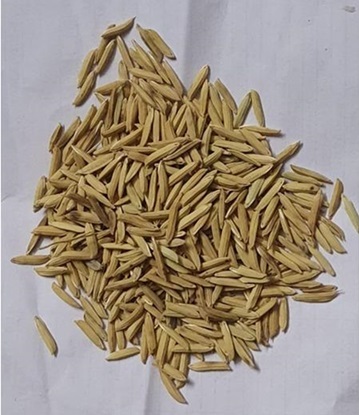
    The ASR Paddy from Chauhan’s Farm
    Armed With Passion, Chintagarhi Pradhan Motiram Converted His Village into a Zero Water Outflow Village

    Armed With Passion, Chintagarhi Pradhan Motiram Converted His Village into a Zero Water Outflow Village

    गांव का पानी गाओं में

    Motiram is the Pradhan [Elected Village Head] of a small village Chintagarhi under the Chandgarhi Panchayat of Hathras Block. The village has only 119 households mostly resided by the socio-economically backward scheduled cast. The village mostly dependent upon farming activities and allied farming activities such as labour. A few of them also earn their livelihood through selling vegetables and working in the rice mill that is situated in the village.

    Motiram, 56, is however the soil of soil wanting to do something extra for the village and the community members. Only in April 2021 he got elected overwhelmingly with the support of the community members with a promise to improve the situation of the village. It however never came into his mind that one way of serving the people would come in the form of water harvesting and it would be brought by an external agency.

    In early 2024 while FORCE was developing intervention plant for Hathras block for its Watershed Health Initiative project funded by PepsiCo India, we came across this village and Motiram who readily agreed to transform his village to z zero water outflow village by restoring the wastewater pond [that never was] and allowing FORCE to create as many rainwater harvesting structures in the village as needed.

    He also passionately supported us in building a learning centre in Chintagarhi.

    We chose Chintagari for its ideal size – small enough for ease of implementation, yet big enough to offer replicability learnings and for the sheer enthusiastic Motiram to do something for his people.

    The Constructed Wet Land

    Chintagarhi, a year back had an area that was demarked by the panchayat as a collection point for the wastewater from the village. However, over the years this place became a marshy place that has reduced the wastewater flow to a small drain that through a channel went to the nearby farm- untreated while the exit point – approx. 3000 sq.m. of silted up, marshy land near the main road – at one end of the village. Also over the time it was a dumping point for garbage for the community and was a source for filth and water borne disease. Part of that land was also used as a livestock waste dumping site. The possibility of being able to use this land to develop a new pond was a key factor influencing our decision to make Chinta Garhi a model GPGM village.

    After we approached Motiram, he saw an opportunity to create a constructed wetland and pond which can serve the dual purpose of cleaning wastewater and storing treated wastewater along with rainwater runoff which could be used by farmers for irrigation.

    We initiated the earthwork and dug 3 meters deep at the centre with proper bunds on the sides. When the pond was ready with the proper channelization of wastewater, the baffle chambers were created for de-silting and de-greasing. Thereafter a reed-bed of three meter deep, two meter wide and ten meters long that bears over 100 plants that bio digest the wastewater.

    The village pond with capacity of 5058.6 cu.m. made that gets treated wastewater through the reed bed. The boundaries of the wetland now bears plants that doubly treat the wastewater and also has a barbed wire fencing to protect any trespass by the villagers or their cattle.

    The Four RWH Structures

    Apart from the wetland we have FORCE also constructed 2 new rainwater harvesting structures having a capacity of 1067 cu.m. 2 Defunct water structures restored with 765.16 KL capacity. One of the RWH has been created in the upper primary school located in the village itself. It is now a centre for attraction and learning space for the children.

    The school by itself has developed a garden were water efficient farming on a small scale is done through broad bed system. The school also bears creative all across the walls – on RWH, climate smart agriculture, WASH learnings etc.

    With the pond approximately filled four times a year the total water harvested annually stands to be 1.69 crore liters per year [16.9 million liters]. The total Capacity thus created is 1.88 crore liters of water.

    Learning Centre

    Another site has been developed especially for children as a ‘learning through play’ kind of learning center.  An RWH puzzle and a snake & ladder game encourages children to learn about water conservation, rainwater harvesting and how they can reduce their water footprint.

    The impact is – the village now has got a new look with migratory birds visiting the pond.  The number of fishes that were release there on the World Fisheries Day in November 2024, have grown. It has become a landmark in the district as Chintagarhi is the first Zero Water Outflow Village. People often visit this village and meet Motiram for advice.

    So much so that the government officials regularly visit this place and inviting FORCE to develop other such places in the district and are now ready to handover the charge of Jal Shakti Kendra mandated by the Jal Shakti Ministry of Government of India.

    Motiram is a people’s hero now. FORCE and PepsiCo India thank him for all his support to maje Chintagarhi a Model Water Village

    Rainwater Harvesting Using Defunct Dug Well – The Aged Well of Parsara

    Rainwater Harvesting Using Defunct Dug Well – The Aged Well of Parsara

    The Story of the Aged Well of Parsara

    Parsara Defunct Dug Well


    Perhaps over one and a half decades have passed, even the villagers don’t remember correctly – this mammoth but defunct dug well in Parsara, one of the prominent villages of Hathras district in Uttar Pradesh is nothing short of a marvel. With a two-meter diameter and 15-meter depth, it has quenched the thirst of more than 300 households over decades. However, with time due to overdraft of water and introduction of mechanized underground lifting of water, this well slowly became dry and lost its relevance to the villagers and has been leading a cursed life. Nonetheless, the structure of the well is quite solid and intact indicating the older generation of the village must have invested quite a bit of their time and money on the dug well – there must have been a sense of dedication and passion because they knew the value of WATER.

    Parsara Defunct Dug WellThen a day came when FORCE got to know about it. It must be shared here that FORCE for the past 20 years has engaged itself in the domain of water conservation across the economic sectors with special focus on water scares regions. Hathras – is one such region where we are working on a Watershed Health Initiative in 20 villages supported by PepsiCo. Under this project we are working with farmers on climate smart water efficient agriculture. We are also working on the supply side by making several RWH structures and restoring defunct water assets which can act as groundwater recharge locations. A model Zero water flow out village is also being developed.

    Coming back to the story of the Parsara well. As soon as FORCE came to know about this beautiful but dry well it immediately decided to restore it for the good of the people. However, some information must be shared with the readers before the story moves ahead.

    Hathras is mostly dependent on groundwater for several of its activities, especially the Hathras block having 658 villages and a population of 15 lakh according to 2011 census. Though it is part of the Indo Gangetic plain, in the past 2 decades, the groundwater level is receding at the rate of 3-4 feet annually. The level that was at 7-10 feet about half a century back is now at 10-150 feet. In some locations it is even 180 feet. This indicates that the bore wells have to be dug deeper and every couple of years fresh investments need to be made for that. Simply put this can’t go on for ever.

    Parsara Defunct Dug WellThe Parsara well is 60 years old or perhaps more, having a capacity to recharge more than 1200 KL groundwater if connected to the rooftops of the nearby households to catch the rains that falls on them. The average annual rainfall in the area is 656 mm. After having worked out the design and plans, we approached the village community for their views on it. We also asked them to give us the permission to connect the well to the roofs of the nearby households. During our interactions with the community in the area we realised that although the wells are dry, the community holds respect for them and uses the defunct dug wells for several religious rituals.

    Fortunately, the villagers and the village Sarpanch understood our point of view and gave us the go head. Survey was carried out, technical calculations, planning and final design was made, and the work orders were given to a qualified contractor.

    Parsara Defunct Dug WellThe well is now connected with the roof of 10 households and one anganwadi school nearby. The structure got readied in early August of 2024. Fortunately, the showers have been better than usual this year and the community is very happy.

    The aged members of the village expect that in a couple of years this well will not only act as groundwater recharge point, but villagers may also be able to draw water from it.

    The Aged well of Parsara is growing young again.

    Parsara Defunct Dug Well

    Credits:
    We are thankful to PEPSICO for the project support and time to time guidance and encouragement. The credit also goes to the village Sarpanch Mr. Manoj Sisodia and villagers who allowed us to carry out the work.

    Definitive Guide to Reduce Water Wastage

    Definitive Guide to Reduce Water Wastage

    Reduce Wastage of Water – the 1st R of Water Conservation

    Every day we read about the shortage of water in India and many other countries. Niti Aayog in one of its reports has suggested that as many as 21 cities will run out of ground water as early as 2020.  Such a scenario always brings up a question – is there really a shortage of water? And the simple answer is NO. There is no shortage of water. Nature gives us more water than our needs. Yes, nature is unable to give us more eater than our greed.

    Quantity of freshwater is fixed – It reaches us after going through 2 cycles – Nature’s Water cycle and Manmade Water Cycle. One of the simplest ways to overcome the perceived shortage of water is to simply prevent wastage of water. It can save a lot of misery, effort and money. And numbers are huge.

    How to Reduce Wastage of Water

    To save water, we follow 5 R’s of Water Conservation. The 1st R of Water Conservation is – Reduce Wastage of Water.

    This article is about how to reduce wastage of water. It is not yet a definitive guide on reduction of wastage of water. But it aims to be with the help of knowledgeable readers such as yourself. We have listed below ways in which we can achieve our objective of water conservation by reducing water wastage. I am sure that we have missed out a few wonderful ideas. It is my request that you share your ideas about how to reduce wastage of water in the comments section below or use the contact us page to share the ideas. We ill incorporate them in the article with due credit to you.

    1. Save one bucket of water each day by reducing the consumption. In a city like Delhi which has a population of 18.5 million, if every person saves 1 bucket a day (15 liters of water), then 27.75 crore liters / day or 10128.75 crore liters / year are saved. This is equal to 42 days requirement of all families in Delhi. (Assumption each family has 5 members who require 130 liters of water every day). This is true for all cities irrespective of the population of the city. If each person saves one bucket of water every day, the total water saved will help sustain all families in the city for 42 days. The question that can be asked now is how you save at least one bucket water every day. Here are some ways to do it:

        1. Use aerators in all taps.
        2. Use dual flush system in the toilets
        3. Use a water mug while brushing your teeth instead of using running tap water in the sink.
        4. Similarly use a water mug or tumbler while shaving and not let the tap water flow as you shave.
        5. It is advisable to turn of the tap while scrubbing / soaping hands. Turn on the tap only to wet the hand and later to rinse the soap off.
        6. Use bucket or a can to water plants instead of a hose pipe.
        7. Mop the floors to clean them instead of using a hose pipe with running water.
        8. Use water in bucket to clean your vehicles instead of hose pipe with running water.
        9. Take bath with water filled in a bucket instead of using a shower. However, if you do not spend too long in the shower (under 5 minutes) then shower bath may be used.
        10. Use a bucket or large container to rinse the utensils instead of using the running tap water.
        11. Use water efficient washing machines that consume lesser water per wash
        12. Use float valves and water level indicators in storage tanks so that there is no water overflow.
        13. Serve half glass of water to your guests. If they need more water, the’ll ask for it.

    2. Reduce water wastage by ensuring that there are no leaking taps. If a tap leaks @ 1 drop / second, we lose 2000 litres/month. If there are two such taps in each house, Delhi loses 49.33 Cr litres / day or 18007 Cr litres / year which is equal to 74 days water requirement of all families of Delhi.

    3. RO filters are a big source of water wastage. In areas where the water is supplied by the municipal corporations, a RO is not really required since the TDS level of the water is quite low. In such cases other form of water purifiers such as UV or gravity filters may be quite enough. However, if you must use RO water purifiers, then the reject water from the RO should be used again. There are many ways in which the RO reject water can be used to reduce the water wastage after the TDS level of the reject water is tested (Water with TDS below 2000 can be used for many purposes)

        1. Cleaning the floor
        2. Watering the plants
        3. Washing vehicles
        4. Washing the utensils
        5. Flushing

    As I have mentioned earlier, there must be many other ways in which water wastage can be reduced. Please share your ideas in the comments section below or write to us through the contact us page.

    Pin It on Pinterest